

New CRISPR tool eliminates undesired cells
A cell’s identity and behavior are determined in part by which of its genes are currently being used and how active they are. Based on this activity pattern, cells can be distinguished and identified within heterogeneous populations. This is especially useful when certain cell types need to be removed, such as those associated with disease or those that have not undergone successful gene editing. Identifying these cells allows for targeted interventions, but eliminating them often depends on the specific context and therefore requires customized approaches. This makes robust and versatile methods for detecting and selectively eliminating such cells highly sought-after tools in basic research, medicine, biotechnology, and agriculture.
When it comes to bacteria, so-called CRISPR technologies already offer promising possibilities for detecting and eliminating specific microbes. They are based on CRISPR-Cas, a bacterial immune system in which a ribonucleic acid (RNA) specifies the target sequence and a Cas protein (from “CRISPR-associated”) acts as a nuclease—that is, an enzyme that cuts DNA. If the guide RNA is selected so that it matches only the DNA of a specific bacterium, that bacterium’s genetic material is precisely recognized. The cut in the genetic material causes severe damage, and the affected bacterium dies.
However, using the same nucleases in eukaryotes—organisms whose cells possess a nucleus containing DNA—has proven significantly more difficult. Researchers apply these nucleases in eukaryotes—and subsequently found a distinct CRISPR strategy to eliminate specific cells.
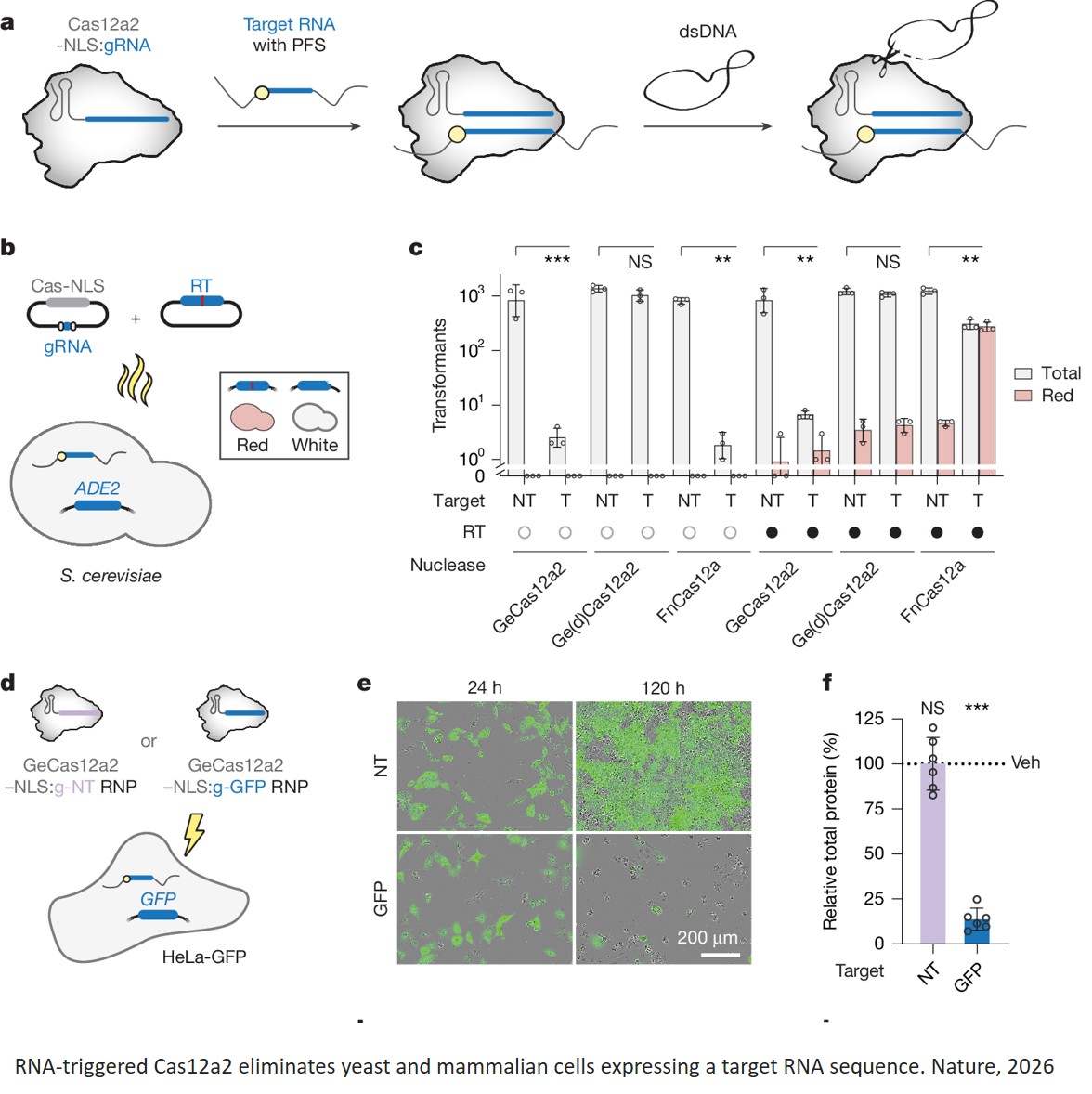
Previous work published in Nature in 2023, showed that the CRISPR nuclease Cas12a2 recognizes RNA target sequences, triggering non-specific cleavage of any nucleic acid it encounters—specifically RNA, single-stranded DNA, and double-stranded DNA.
“This activity leads to extensive DNA damage in bacteria, causing a halt in growth and thus preventing the spread of a recognized invader,” says one of the corresponding authors of the study published in Nature.
“In contrast to activated Cas9, which makes a single precise cut in the bound DNA, RNA target-activated Cas12a2 shreds all DNA it encounters, effectively killing the cell,” says a co-corresponding author on the paper. “Its goal is not to correct anything. Instead, it’s to destroy anything it sees,” adds another corresponding author of the study.
However, it was unknown what would happen if Cas12a2 were triggered in eukaryotic cells—until now. The team of scientists and industry researchers found that Cas12a2 in yeast and human cells inactivated those containing the target transcript but spared those lacking the target sequence. “Cell death was sequence-specific, showed high sensitivity to mismatches, and occurred without any measurable unintended effects,” says the author.
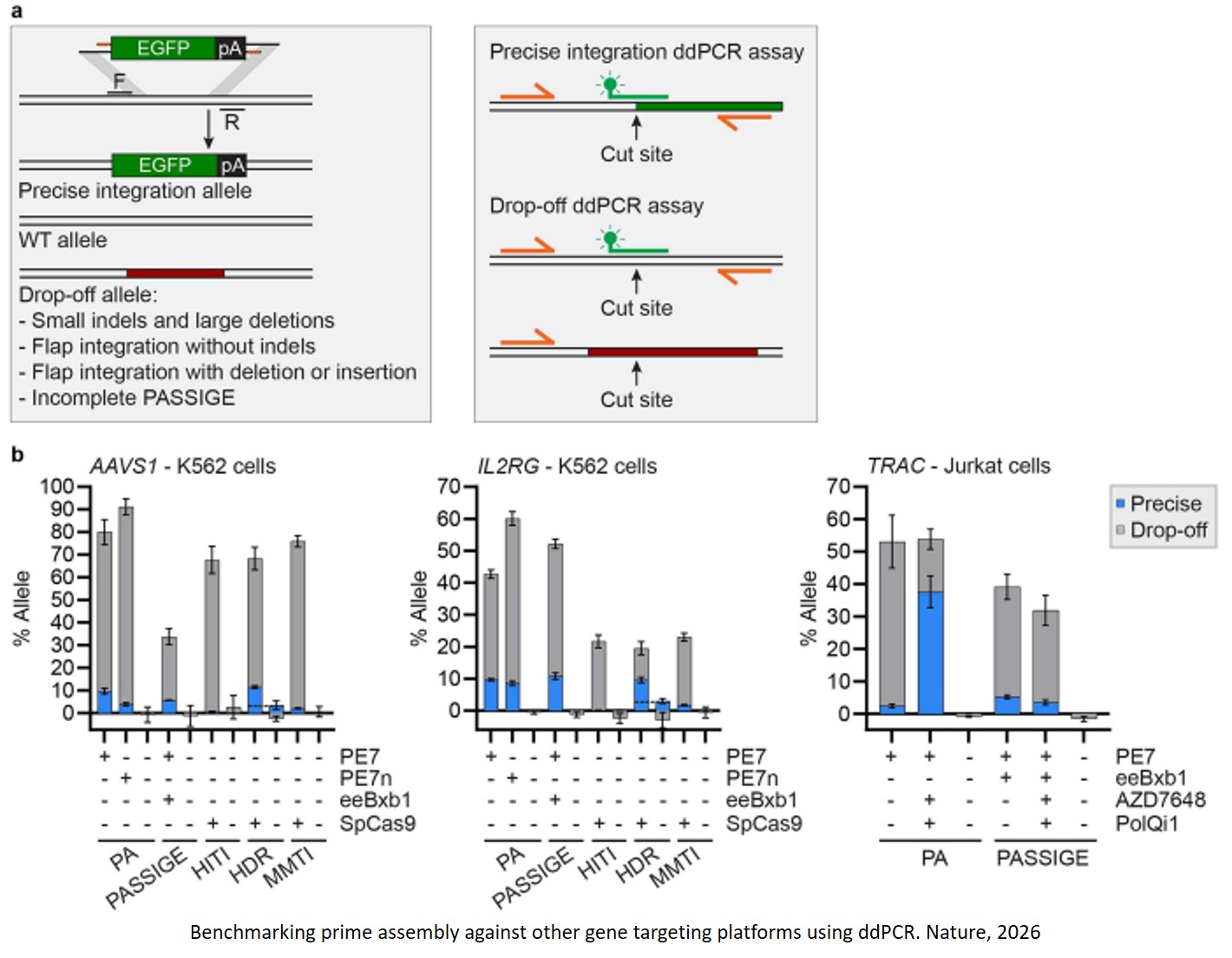
“Our technology provides us with a powerful tool for sequence-specific depletion of pathogenic cells,” says the first and corresponding author of the publication. “In this study, we demonstrate the potential by targeting virus-infected cells as well as cancer cells transformed by a point mutation. However, our technology is programmable to target almost any RNA signature.” Another possible application is to selectively remove unmodified cells to enrich successfully modified cells, thereby improving the quality of gene editing—something the team was also able to achieve in this study.
Given its in vitro activity—that is, under laboratory conditions and outside living organisms—the effect of activated Cas12a2 was to be expected. However, there was no guarantee of what would happen if it were released in a human cell: Initially, the team was concerned that Cas12a2 might eliminate cells other than the target cells if it were inadvertently triggered by RNA present elsewhere. However, this was not the case.
From oncology and chronic infections to gene editing: The ability to selectively eliminate cells based on their transcriptome opens up new possibilities. “Because Cas12a2 can be programmed with a guide RNA to target any RNA sequence, and it shows little to no off-targeting, we believe we have discovered a way to selectively kill cells across all of biology,” the author says.
“We show it can be used to enrich for gene editing, and to selectively kill cells harboring virus genes, and to kill cells with acquired mutations. We envision this technology will transform science, agriculture and medicine in ways previously unavailable.” The author adds: “We hope the research community will explore these new possibilities in greater detail, determining how they can be improved and applied beyond our proof-of-principle study.” The research team itself plans to continue developing Cas12a2 for clinical applications. At the same time, they will investigate ways to improve and expand the technology.
https://www.nature.com/articles/s41586-026-10466-y
https://sciencemission.com/CRISPR%E2%80%93-Cas12a2-for-cell-killing